
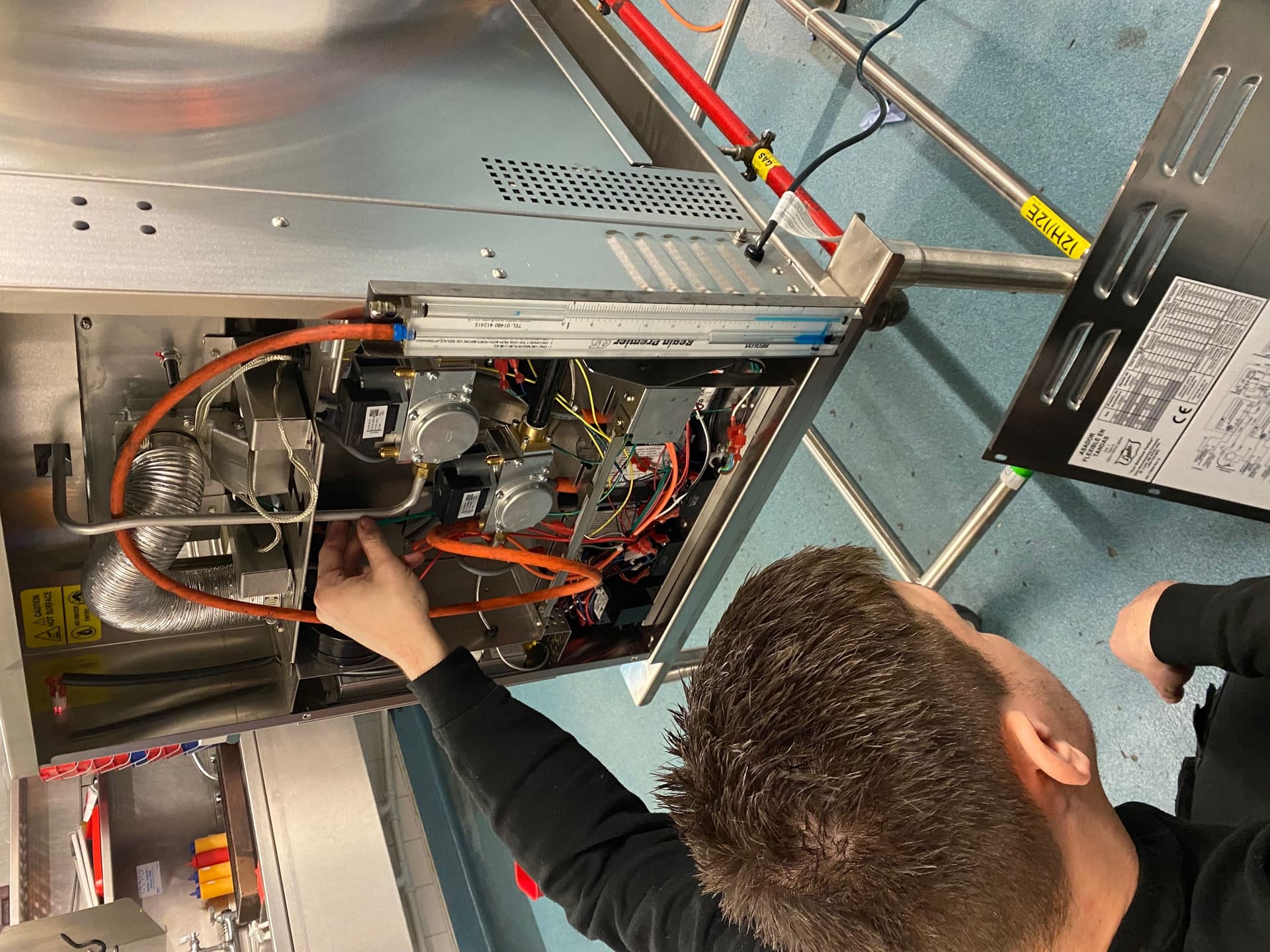
EICR Cost for Commercial Kitchens — 2026 UK Price Guide
Every commercial kitchen, restaurant, hotel and hospitality site in the UK is required to hold a current Electrical Installation Condition Report (EICR) — sometimes called a fixed-wire test or periodic inspection. It is one of the most-quoted electrical services and one of the most variably priced.
This 2026 UK price guide explains what an EICR really costs for a commercial kitchen or hospitality site, what affects the price, and where operators commonly overpay.
What is an EICR?
An EICR is a comprehensive inspection and test of the fixed electrical installation of a building. It checks the consumer unit, distribution boards, circuits, sockets, switches and protective devices to verify they are safe to use and meet current BS 7671 wiring regulations.
For commercial premises, EICRs are required:
- Every 5 years as a maximum interval (or sooner if recommended by the previous inspection)
- By your buildings insurer
- By most landlords and commercial lease agreements
- By brand operators (in the case of franchise sites)
- By Environmental Health and Trading Standards inspectors
The EICR must be carried out by a competent electrical contractor — for commercial premises this typically means an NICEIC approved contractor, which is the gold standard for third-party electrical certification in the UK.
Realistic 2026 UK EICR Pricing
EICR cost is primarily driven by the number of circuits in the installation, not the floor area or number of sockets. A typical commercial kitchen has 20–60 circuits depending on size and equipment density.
| Site Profile | Typical Circuit Count | Typical 2026 Price (ex VAT) |
|---|---|---|
| Small restaurant / café | 10–25 | £350–£550 |
| Mid-size restaurant / pub kitchen | 25–50 | £550–£900 |
| Hotel / banqueting kitchen | 50–120 | £900–£1,800 |
| Large catering site / care home | 80–150+ | £1,200–£2,500+ |
| Multi-site PPM (per site) | Varies | Typically 25–40% discount on standalone |
Important context: the figures above are for the EICR inspection and reporting only. Any remedial work required to bring the installation up to a satisfactory condition is quoted separately. Reputable NICEIC contractors will always categorise findings (C1, C2, C3) and quote remediation transparently.
What Affects EICR Price?
1. Circuit count
This is the single biggest cost driver. Every circuit must be individually tested — insulation resistance, polarity, earth fault loop impedance, RCD operation. The more circuits, the more engineer time.
2. Three-phase supply
Most commercial kitchens are three-phase. Three-phase EICRs take longer than single-phase domestic-type tests and are priced accordingly.
3. Accessibility
If circuits feed equipment that cannot be safely isolated during trading hours — walk-in cold rooms, IT systems, security — testing has to be phased or scheduled out-of-hours, which adds cost.
4. Documentation quality
If your previous EICR is missing or incomplete, the engineer has to trace the installation from scratch. This typically adds 1–3 hours to the inspection. A well-documented installation with circuit charts is significantly cheaper to test.
5. Multi-site discounts
Operators with multiple sites benefit substantially from a PPM contract. Per-site EICR cost on a national PPM is typically 25–40% lower than standalone rates, with scheduling and documentation consolidation included.
Understanding C1, C2 and C3 Categorisations
Every EICR finding is categorised:
- C1 — Danger present. Risk of injury. The circuit or appliance must be isolated immediately. Common examples: exposed live conductors, missing earthing, severely damaged wiring.
- C2 — Potentially dangerous. Remedial action required. Common examples: missing RCD protection on relevant circuits, deteriorated cable sheathing, undersized protective devices.
- C3 — Improvement recommended. Not dangerous but the installation could be improved. Often relates to BS 7671 amendments since the original installation.
An EICR can only be marked "satisfactory" if there are no C1 or C2 findings. C3 findings are advisory and do not invalidate the certificate.
Where Operators Commonly Overpay
- Single-visit standalone EICRs when a multi-site PPM would cost a fraction per site.
- Paying for "discovery" remediation without prior quotation. Reputable contractors itemise C1, C2 and C3 findings and quote remediation separately for your decision.
- Replacing entire consumer units when targeted remedial work would suffice. Some contractors default to recommending consumer unit replacement; this is sometimes appropriate but should be justified by the findings, not assumed.
- Paying for unnecessary out-of-hours work. EICRs can often be phased across two or three day-time visits to avoid out-of-hours premium pricing.
- Combining EICR and PAT incorrectly. EICR covers the fixed installation; PAT covers portable appliances. They are not interchangeable and should be priced separately.
What Should Be Included in Your EICR Quote?
A good commercial EICR quote should include:
- Full inspection of the fixed electrical installation (consumer unit, distribution boards, every circuit)
- Insulation resistance, polarity, earth fault loop impedance and RCD testing on every circuit
- Visual inspection of accessories, isolators and protective devices
- Issue of the EICR certificate (Satisfactory or Unsatisfactory) on completion
- Categorised findings with C1, C2 and C3 codes
- Itemised quote for any remedial work required
- NICEIC certification of the report
How HK Engineering Quotes EICR Work
For multi-site operators we quote per-site EICR pricing as part of a wider PPM contract that consolidates electrical, gas, PAT and emergency lighting compliance. For standalone sites we quote a fixed price after a brief profile call covering circuit count, three-phase status, and any out-of-hours requirements.
HK Engineering is an NICEIC approved contractor, meaning every certificate we issue carries third-party verification accepted by all UK insurers, EHO inspectors and major brand auditors.
For an EICR quote on a single commercial kitchen or across an estate of sites, give our team a call on 01225 791848 or use our callback form. We cover all of England and Wales.
Related Articles
How Much Does a CP42 Commercial Gas Safety Certificate Cost in 2026?
Read Article
Rational vs Unox: Which Combi Oven is Right for Your Commercial Kitchen?
Read Article


